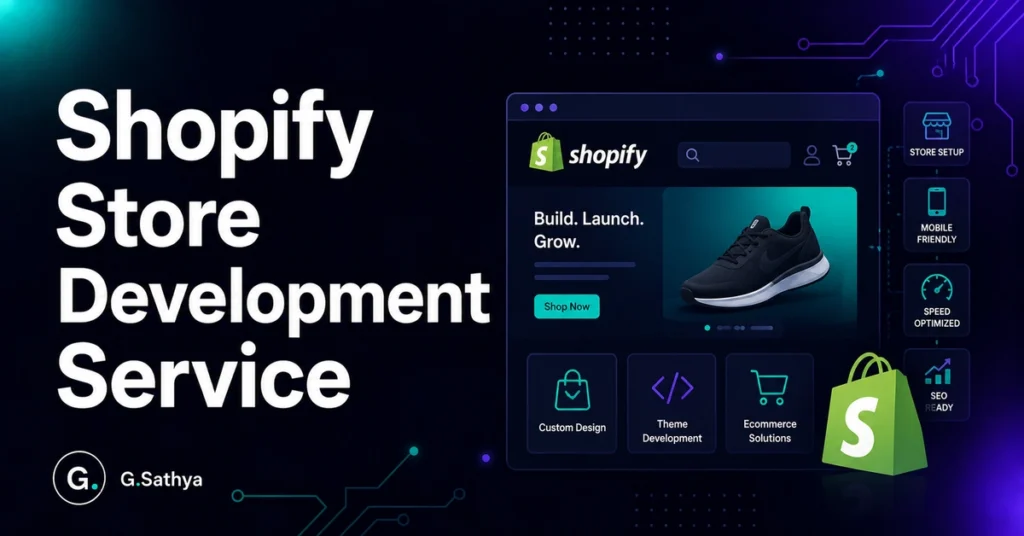
Shopify store development is the complete process of launching and configuring an ecommerce business on Shopify—from theme selection and visual customization to payment gateway integration, shipping profiles, and automated invoicing—built to convert global shoppers without technical headaches.
Whether you are launching your first direct-to-consumer (D2C) brand or migrating an established retail business to Shopify, you do not need to be a software programmer to operate a world-class online store. Over the past decade building and optimizing high-growth Shopify stores for founders across the United States, United Kingdom, Europe, Australia, Canada, the UAE, and India, I have created this practical merchant guide to explain exactly how Shopify works, where key settings live, how to safely customize your storefront without writing code, and when to bring in an experienced developer for custom features.
Shopify Setup Options Compared: DIY Setup vs. Developer-Built Storefront
Understanding what you can comfortably manage yourself versus what requires developer expertise saves both time and revenue:
| Store Setup Area | Can You Do It Yourself (DIY)? | Where It Lives in Shopify | When to Hire a Specialist |
|---|---|---|---|
| Theme Customization (No Code) | Yes (Drag & Drop) | Online Store → Themes → Customize | When you need bespoke layouts, unique interactive calculators, or custom product builders |
| Payment Gateways & Checkout | Yes (Standard Setup) | Settings → Payments | When configuring multi-currency routing, local payment gates (UPI/Razorpay/Klarna), or checkout extensions |
| Shipping Rates & Delivery Zones | Yes (Profile Rules) | Settings → Shipping and delivery | When integrating custom courier APIs, pincode validation, or dynamic freight tables |
| GST / VAT Invoicing & Compliance | Moderate | Settings → Taxes and duties | When setting up automated B2B GST invoices, international VAT reverse-charges, or custom PDF receipts |
| Custom Upsells & High-Speed Performance | Requires Developer | Theme code & App embeds | To build native one-click upsells and bundle offers without paying $50-$200/month for bloated apps |
Step 1: Setting Up Global Payments & Checkout
Your payment configuration is where visitors convert into paying customers. Setting it up correctly ensures your store accepts transactions worldwide without high gateway rejection rates.
- Navigate to Settings → Payments: Here you can activate your primary payment provider. If you operate in the US, UK, Canada, Australia, or Europe, enable Shopify Payments to instantly accept Visa, Mastercard, American Express, Apple Pay, Google Pay, and Shop Pay with zero extra transaction fees.
- PayPal Express Checkout: Always activate PayPal alongside credit card processing. For international buyers in Germany, the UK, and the US, over 30% of shoppers prefer completing purchases via PayPal.
- Regional Gateways (India & Middle East): If you sell in India, connect Razorpay, Cashfree, or PayU to enable instant UPI payments, Netbanking, and Cash on Delivery (COD). For the UAE and Saudi Arabia, integrate Tabby, Tamara, or Telr.
- Test Mode Before Launch: Place a real test transaction using the Bogus Gateway or a $1 live checkout to confirm that order receipts and SMS notifications fire accurately.
Step 2: Configuring Shipping Charges & Delivery Profiles
Unclear shipping costs are the #1 cause of cart abandonment. All shipping rules are configured under Settings → Shipping and delivery:
- General Shipping Profile: Define your standard delivery rates. Group destinations into Domestic (your home country) and International Zones (e.g. North America, Europe, Australia, Rest of World).
- Flat Rate vs. Free Shipping Thresholds: High-converting stores offer a flat shipping fee (e.g. $4.99 or ₹99) and unlock Free Shipping on orders above a set value (e.g. “Free Shipping on Orders Over $75 / ₹1,499”). You can easily set this up by adding a condition based on order price.
- Carrier-Calculated Shipping: If you sell heavy or variable-weight products, connect live carrier accounts (FedEx, UPS, DHL, Australia Post, India Post) so exact rates are calculated automatically at checkout based on package dimensions.
Step 3: Mastering the Shopify Theme Structure Without Writing Code
Modern Shopify themes (built on Online Store 2.0) are completely visual. You do not need to edit Liquid code or CSS to create a beautiful, professional storefront. Everything is controlled under Online Store → Themes → Customize:
- Header & Announcement Bar: Upload your brand logo, set header navigation menus, and use the announcement bar to highlight discounts, shipping policies, or contact numbers.
- Modular Drag-and-Drop Sections: Every page is assembled from modular sections—including Image Banners, Featured Collections, Rich Text, Video, and Multi-Column grids. You can add, delete, hide, or reorder these sections with one click.
- Customizable Blocks: Inside each section, you can fine-tune individual elements (text headings, buttons, star ratings, and product badges).
- Theme Settings (Global Branding): Click the gear icon (Theme Settings) to define your brand’s global color palette, typography font pairings, button corner radiuses, and social media links across all pages at once.
Step 4: The Golden Rule of Theme Editing: The Backup Workflow
One of the most dangerous mistakes store owners make is editing their active, published theme while customers are actively shopping. Any accidental deletion or misaligned banner is instantly visible to the world.
Always follow this professional, zero-risk theme workflow:
- ✓
Step 1: Duplicate Your Theme (Create Backup): Go to Online Store → Themes, click the three dots (…) next to your live theme, and select Duplicate. This creates an exact copy labeled “Copy of [Theme Name]”.
- ✓
Step 2: Rename Your Draft Theme: Click the three dots on the duplicate and rename it with today’s date and purpose (e.g. “Theme Update – Festive Sale Draft”).
- ✓
Step 3: Edit and Preview Privately: Click Customize on the unpublished draft theme. Test new banners, rearrange collections, and preview on both mobile and desktop without affecting live visitors.
- ✓
Step 4: Publish When 100% Ready: Once your changes are verified and approved, simply click Publish on the draft theme. The new version replaces the live site instantly with zero downtime.
When Should You Hire a Developer for Custom Shopify Work?
While Shopify’s visual theme editor handles 80% of daily merchandising, scaling an ecommerce brand eventually requires specialized engineering. Installing too many monthly subscription apps slows down your store and cuts into profits. Here is where an experienced senior developer adds massive value:
🚀 Advanced Shopify Development Services by Sathyaseelan G.
If your store needs custom features that standard themes or basic apps cannot provide, I can engineer clean, update-safe solutions directly into your theme:
- Custom One-Click Upsells & Cross-Sells: Native cart drawer recommendations and sticky add-to-cart bars without paying $30-$100/month for heavy third-party apps.
- Bespoke Layouts & Section Development: Custom product comparison tables, interactive before/after sliders, and unique brand storytelling modules.
- Automated GST / Tax Invoice Compliance: Seamless automated GST tax calculation, B2B customer GSTIN capture, and branded PDF invoice generation for Indian and international businesses.
- Speed Optimization & Core Web Vitals: Sub-2-second mobile load time tuning, app script consolidation, and high-performance WebP media delivery.
- Third-Party CRM & ERP Integrations: Automatic synchronization of orders, inventory, and customer records to HubSpot, Zoho, Klaviyo, or custom logistics software.
Need help with your Shopify store? Contact me directly for a fixed quote and technical consultation.
Frequently Asked Questions About Shopify Store Development
How do I know where shipping charges are configured in Shopify?
All shipping charges, package dimensions, free shipping thresholds, and international delivery zones are located in your Shopify admin under Settings → Shipping and delivery. You can create different shipping profiles for standard products versus fragile or bulky items.
Can I edit my Shopify theme without touching any code?
Yes. Online Store 2.0 themes are designed for non-technical merchants. By going to Online Store → Themes → Customize, you can visually drag and drop sections, add banners, edit text, change button colors, and swap product collections in real time.
What is the safest way to update my Shopify theme without breaking the live store?
Always duplicate your active theme first! Go to Online Store → Themes, click the three dots next to your live theme, and select Duplicate. Work and preview your changes inside the unpublished duplicate. Once you are completely satisfied, click Publish to go live instantly with zero downtime.
How do I collect GST numbers and issue GST invoices in Shopify?
For Indian businesses, you can capture customer GSTIN numbers by adding a custom field to the cart drawer or order notes. Invoices can be generated automatically using certified GST billing apps (such as Sufio or dedicated GST apps) or through custom developer integration, ensuring compliant tax breakdowns and HSN code printing.
Why is my Shopify store getting slow after installing apps?
Every app you install from the Shopify App Store injects extra JavaScript files and external stylesheets into your theme. When you install 15 or 20 apps, they compete to load simultaneously, slowing down mobile page speeds. A developer can build many of these features natively into your theme, eliminating the need for bulky apps.
Do you work with Shopify clients internationally outside of India?
Yes. Over 70% of my Shopify client projects are delivered for ecommerce brands and agencies across the United States, United Kingdom, Europe, Canada, Australia, and the UAE. I help international stores configure multi-currency Shopify Markets, localized checkout flows, and automated international fulfillment.
Get Professional Help with Your Shopify Store
Building a successful ecommerce brand requires getting the fundamentals right—from frictionless checkout and transparent shipping to fast mobile loading and automated tax invoicing. If you need assistance configuring your store, developing custom layouts, or optimizing checkout conversions, I am here to help.
Explore my dedicated Shopify Store Development Services or contact me directly for personalized guidance on your store.