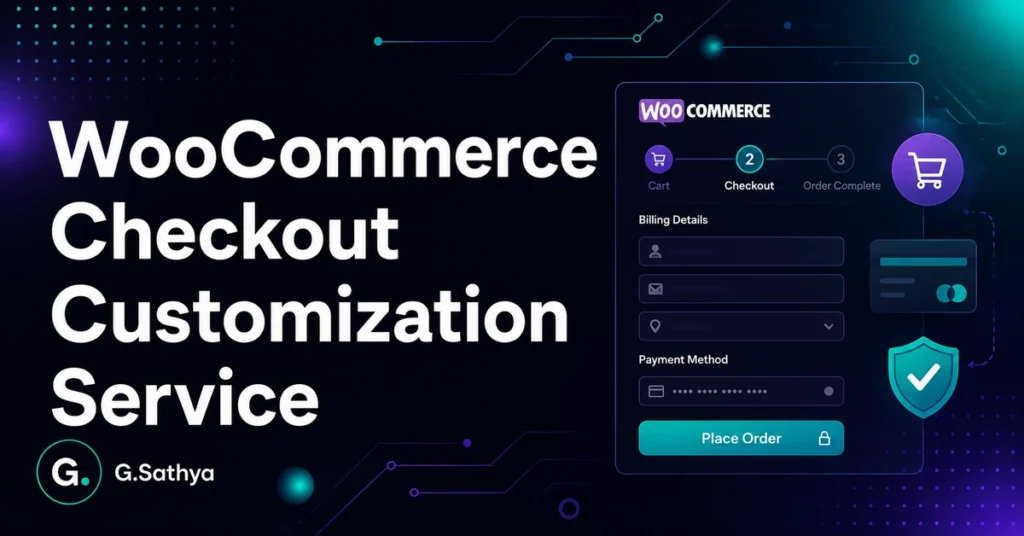
WooCommerce checkout customization is the technical process of modifying, streamlining, or rebuilding the default WooCommerce checkout funnel using action and filter hooks, custom order meta, conditional gateway logic, and modern UX patterns. A properly customized checkout directly eliminates purchase friction, slashes cart abandonment by 20% to 35%, and captures critical business data without slowing down transaction speed.
Over the last decade developing high-volume ecommerce stores across India, the US, UK, and Europe, I have seen standard, bloated checkouts cost merchants hundreds of thousands of dollars in lost conversions. Out of the box, WooCommerce requires over 14 form fields—many of which are completely useless for digital goods, B2B procurement, or local delivery. This technical guide breaks down the exact developer strategies and production code needed to customize your WooCommerce checkout for maximum speed, security, and conversion rates.
Checkout Architecture Comparison: Which Solution Fits Your Store?
Modern WooCommerce offers multiple ways to structure the purchasing experience. Before writing custom code, choose the right foundation based on your store’s requirements:
| Checkout Architecture | Conversion Impact | Hook & API Flexibility | Payment Gateway Compatibility | Best For |
|---|---|---|---|---|
| Hook-Driven Classic Checkout | High (when optimized) | 100% (Hundreds of native hooks) | Universal across all 300+ payment gateways | Bespoke B2B workflows, complex custom fields, custom shipping logic |
| WooCommerce React Blocks | Moderate | Limited (Requires React / Gutenberg API) | Growing (Major gateways only) | Standard B2C physical goods stores with minimal customization needs |
| One-Page Funnel (Ajax Cart + Checkout) | Maximum (+25-35%) | High (Custom template / Micro-app) | Full support via WooCommerce endpoints | Direct-to-Consumer (D2C) hero products, flash sales, high-speed landing pages |
| Heavy Third-Party Multi-Step Plugins | Low (High TTFB / Bloat) | Locked to vendor proprietary settings | Frequent script conflicts | Avoid. Causes slow mobile execution and JS errors. |
Step 1: Removing Unnecessary Fields to Eliminate Checkout Friction
Every unnecessary field added to a checkout form reduces conversion probability by an estimated 3% to 5%. If you sell digital downloads or domestic physical products, you do not need company names, second address lines, or billing phone numbers.
Use the woocommerce_checkout_fields filter hook in your custom MU-plugin to unset unused fields cleanly without breaking core order data:
<?php
/**
 * Streamline WooCommerce Checkout Fields.
 * Strips non-essential fields to minimize user friction.
 */
add_filter('woocommerce_checkout_fields', 'sathya_optimize_checkout_fields', 9999);

function sathya_optimize_checkout_fields($fields) {
    // Remove non-essential billing fields
    unset($fields['billing']['billing_company']);
    unset($fields['billing']['billing_address_2']);
    unset($fields['billing']['billing_state']); // If operating in single-state / non-state territory

    // For virtual or digital products, strip physical shipping requirements entirely
    if (!WC()->cart->needs_shipping()) {
        unset($fields['billing']['billing_postcode']);
        unset($fields['billing']['billing_country']);
    }

    // Improve input styling attributes
    if (isset($fields['billing']['billing_email'])) {
        $fields['billing']['billing_email']['class'][] = 'sathya-input-highlight';
        $fields['billing']['billing_email']['placeholder'] = 'your.email@example.com (For instant order tracking)';
    }

    return $fields;
}
Step 2: Adding Custom Checkout Fields with HPOS-Compatible Order Meta
When collecting custom business data—such as a preferred delivery date, GST/tax identification number, or gift message—you must validate the input on the server side and save it cleanly to both order meta and modern High-Performance Order Storage (HPOS) tables.
<?php
/**
 * 1. Render custom checkout field after order notes.
 */
add_action('woocommerce_after_order_notes', 'sathya_render_delivery_date_field');

function sathya_render_delivery_date_field($checkout) {
    echo '<div class="sathya-custom-checkout-field"><h3>' . __('Scheduled Delivery', 'woocommerce') . '</h3>';

    woocommerce_form_field('delivery_date', [
        'type'        => 'date',
        'class'       => ['form-row-wide'],
        'label'       => __('Preferred Delivery Date', 'woocommerce'),
        'required'    => true,
        'custom_attributes' => [
            'min' => date('Y-m-d', strtotime('+1 day')),
            'max' => date('Y-m-d', strtotime('+14 days'))
        ],
    ], $checkout->get_value('delivery_date'));

    echo '</div>';
}

/**
 * 2. Validate custom field on server side.
 */
add_action('woocommerce_checkout_process', 'sathya_validate_delivery_date');

function sathya_validate_delivery_date() {
    if (empty($_POST['delivery_date'])) {
        wc_add_notice(__('Please select a valid preferred delivery date.', 'woocommerce'), 'error');
        return;
    }

    $selected = strtotime(sanitize_text_field($_POST['delivery_date']));
    $tomorrow = strtotime('+1 day 00:00:00');

    if ($selected < $tomorrow) {
        wc_add_notice(__('Delivery date must be at least 24 hours in advance.', 'woocommerce'), 'error');
    }
}

/**
 * 3. Save to HPOS and Order Meta.
 */
add_action('woocommerce_checkout_create_order', 'sathya_save_delivery_date_order_meta', 20, 2);

function sathya_save_delivery_date_order_meta($order, $data) {
    if (!empty($_POST['delivery_date'])) {
        $clean_date = sanitize_text_field($_POST['delivery_date']);
        $order->update_meta_data('_preferred_delivery_date', $clean_date);
    }
}
Step 3: Conditional Payment Gateways Based on Order Value & Products
Cash on Delivery (COD) carries significant shipping risk on high-value items, while credit card processing fees cut heavily into small micro-transactions. With a custom filter, you can dynamically restrict or enable payment gateways according to real-time cart contents:
<?php
/**
 * Conditionally disable Cash on Delivery (COD) for orders exceeding $1,000
 * or when virtual/downloadable products are present in the cart.
 */
add_filter('woocommerce_available_payment_gateways', 'sathya_restrict_gateways_dynamically');

function sathya_restrict_gateways_dynamically($available_gateways) {
    if (is_admin() || !WC()->cart) {
        return $available_gateways;
    }

    $cart_total = WC()->cart->get_total('edit');
    $has_virtual = false;

    foreach (WC()->cart->get_cart() as $cart_item) {
        if ($cart_item['data']->is_virtual() || $cart_item['data']->is_downloadable()) {
            $has_virtual = true;
            break;
        }
    }

    // Disable COD for high ticket carts or digital goods
    if (isset($available_gateways['cod'])) {
        if ($cart_total > 1000 || $has_virtual) {
            unset($available_gateways['cod']);
        }
    }

    return $available_gateways;
}
Step 4: Dynamic Auto-Discounts and Surcharges on Checkout
Offering incentives at checkout—such as free shipping thresholds, payment method discounts (e.g. 5% off for instant UPI/Credit Card vs COD), or packing surcharges—drives conversions and covers operational expenses:
<?php
/**
 * Automatically apply a 5% prepayment incentive discount
 * when customer selects direct bank transfer or online gateway.
 */
add_action('woocommerce_cart_calculate_fees', 'sathya_apply_prepayment_discount', 20, 1);

function sathya_apply_prepayment_discount($cart) {
    if (is_admin() && !defined('DOING_AJAX')) {
        return;
    }

    $chosen_gateway = WC()->session->get('chosen_payment_method');

    // Reward instant prepayment gateways (Stripe, Razorpay, etc.)
    if (in_array($chosen_gateway, ['stripe', 'razorpay', 'bacs'])) {
        $subtotal = (float) $cart->get_subtotal();
        $discount = -($subtotal * 0.05); // 5% instant discount

        $cart->add_fee(__('Prepayment Instant Discount (5%)', 'woocommerce'), $discount, true);
    }
}
Pre-Launch Checkout Quality Assurance & Conversion Checklist
Before launching a newly customized checkout on a live ecommerce store, run through this rigorous quality audit:
- ✓
HPOS Compatibility: All custom fields and meta keys save via
$order->update_meta_data()instead of legacy raw SQL or obsolete postmeta functions. - ✓
Server-Side Validation: Required custom fields are strictly validated via PHP with clear, friendly user error messages.
- ✓
Mobile Responsive Layout: Form inputs feature appropriate HTML5 input types (
type="tel",type="email",type="number") to trigger native mobile keypads. - ✓
Ajax Cart Updating: Price calculations and conditional payment gateways reload seamlessly on the
update_checkouttrigger without full-page reloads. - ✓
Admin & Email Visibility: Custom order meta is cleanly formatted and displayed on the WooCommerce Admin Order screen and customer order confirmation emails.
- ✓
Payment Webhook Security: Payment gateway callbacks handle asynchronous webhooks securely without race conditions or duplicated orders.
Frequently Asked Questions About WooCommerce Checkout Customization
Can I customize WooCommerce checkout without installing heavy plugins?
Yes. In fact, writing lean, hook-driven custom code inside an MU-plugin is significantly better than installing bloated commercial checkout plugins. Custom code loads zero unnecessary CSS or JS libraries, prevents script conflicts, and ensures page load times under 1.5 seconds.
Will custom checkout fields work with WooCommerce High-Performance Order Storage (HPOS)?
Yes, provided you use the official WooCommerce CRUD methods (such as $order->update_meta_data() and $order->save()) rather than direct wp_postmeta database queries. All code examples in this guide are 100% HPOS-ready and backward compatible.
How do I show custom checkout fields in customer email receipts?
You can hook into woocommerce_email_order_meta_fields or woocommerce_order_details_after_order_table to output the saved custom meta values directly inside HTML and plain-text order confirmation emails.
What is the difference between Classic Checkout and WooCommerce Checkout Blocks?
Classic Checkout uses traditional WordPress PHP template hooks and allows infinite server-side customization with standard action and filter hooks. Checkout Blocks uses a React-based Gutenberg interface; while modern in appearance, extending it requires JavaScript slot-fill architecture and has more limited gateway compatibility.
How does custom checkout design reduce shopping cart abandonment?
A customized checkout eliminates non-essential form fields, enables guest checkout, auto-fills address details, presents clear security badges, and dynamically highlights preferred payment options, removing the primary psychological and friction barriers to completing a purchase.
Can I customize the checkout page for specific countries or currencies?
Yes. By tapping into the woocommerce_checkout_fields and woocommerce_available_payment_gateways hooks, you can dynamically show or hide fields and payment methods based on the customer’s geolocated or selected shipping country.
Need a High-Converting WooCommerce Checkout Funnel?
If your store is losing revenue to cart abandonment or requires custom B2B checkout logic, I can help. With over a decade of deep WooCommerce and full-stack engineering experience, I build lightning-fast, custom checkout funnels tailored to your exact business specifications.
Explore my WooCommerce Development Services or contact me directly for a comprehensive checkout performance and conversion audit.