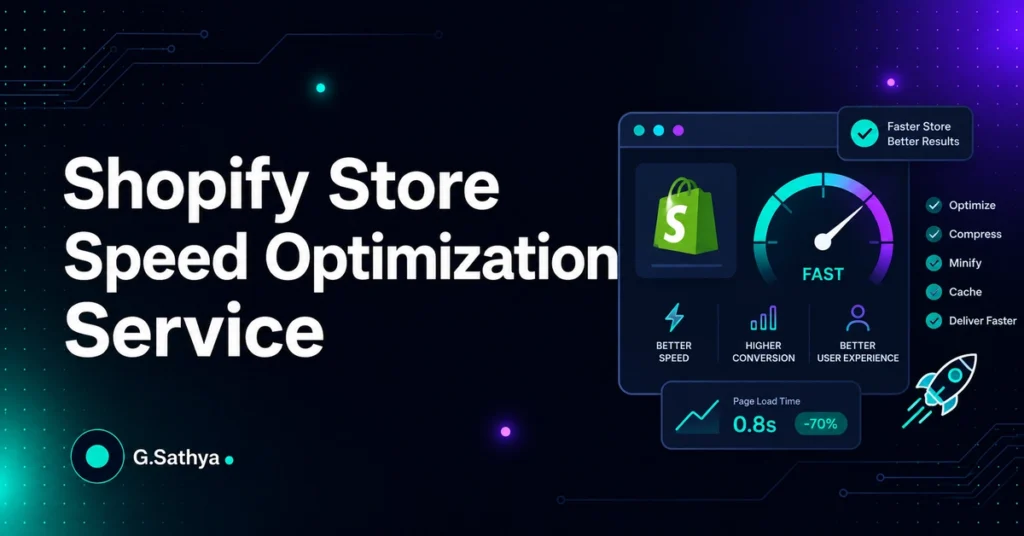
Shopify store speed optimization is the technical performance tuning of Liquid templates, third-party application scripts, media assets, and Google Core Web Vitals (LCP, INP, CLS) to achieve mobile load times under 2 seconds, improve search rankings, and increase ecommerce conversion rates by 15% to 30%.
Over the last decade optimizing high-volume Shopify and Shopify Plus stores for brands across India, the US, UK, and Europe, I have consistently found that 80% of store slowness is caused not by Shopify’s servers, but by accumulated app script bloat and unoptimized theme Liquid code. Because Shopify hosts its infrastructure on a globally distributed CDN with Cloudflare edge caching, merchants have immense native speed potential—if their frontend codebase is kept clean and lightweight.
Shopify Performance Leaks Compared: Where Is Your Store Losing Speed?
Pinpointing the exact bottlenecks in your Shopify store prevents wasted time on ineffective fixes. Here is how common performance leaks impact real-world mobile shoppers:
| Performance Bottleneck | Load Time Impact | Core Web Vitals Affected | Fix Difficulty | Recommended Solution |
|---|---|---|---|---|
| App Script Bloat (15+ Apps) | Severe (+2.5s to +4s) | INP (Interaction to Next Paint) / TBT | Moderate | Audit & uninstall unused apps; defer scripts on user interaction |
| Unoptimized Hero Banners | High (+1.5s to +3s) | LCP (Largest Contentful Paint) | Low | Serve modern WebP/AVIF with fetchpriority="high" and responsive srcset |
| Orphaned “Ghost” App Code | Moderate (+0.5s to +1.5s) | Total Blocking Time (TBT) | Moderate | Manually purge old tracking tags & snippets from theme.liquid |
| Heavy Web Fonts (3+ Families) | Moderate (+0.5s to +1s) | CLS (Cumulative Layout Shift) / FCP | Low | Switch to system font stacks or preload single critical WOFF2 weights |
| Complex Liquid Loops in Sections | Moderate (+300ms to +800ms) | TTFB (Time to First Byte) | Advanced | Refactor nested {% for %} collection loops to single-pass logic |
The 5 Pillars of Enterprise Shopify Speed Optimization
Transforming a slow Shopify store into a sub-2-second experience requires tackling five essential architectural areas:
- Third-Party App Rationalization & Lazy Loading: Review every installed app. Any marketing app (review widgets, live chat, popups, heatmaps) not required above the fold should be asynchronously loaded only after initial render or upon user interaction.
- Image & Media Modernization: Deliver responsive images with precise
sizesattributes, eliminating 4MB PNG hero images and replacing them with modern WebP versions formatted via Shopify’s native image CDN filters. - Liquid Template Efficiency: Remove recursive loops that scan every product in a collection, avoid repeated
all_productscalls, and keep Liquid execution times under 200ms at the server edge. - Core Web Vitals Compliance: Reserve explicit width and height aspect ratios on all containers to achieve a CLS score under 0.1, prioritize the hero banner to drop LCP under 2.5s, and break up long JavaScript tasks to keep INP under 200ms.
- theme.liquid Sanitation: Strip abandoned tracking pixels, defunct review app stylesheets, and dead snippet inclusions left behind after apps were uninstalled from the admin.
Technical Implementation 1: High-Performance Hero Image with Responsive Liquid
The Largest Contentful Paint (LCP) element on most Shopify stores is the homepage hero banner. Loading it lazily or without dimensions destroys mobile performance scores. The following Liquid pattern preloads the mobile and desktop hero images with highest priority and modern responsive breakpoints:
<!-- Preload LCP Hero Banner inside theme.liquid <head> -->
{%- if template.name == 'index' and section.settings.image != blank -%}
  <link
    rel="preload"
    as="image"
    href="{{ section.settings.image | image_url: width: 750, format: 'webp' }}"
    imagesrcset="
      {{ section.settings.image | image_url: width: 375, format: 'webp' }} 375w,
      {{ section.settings.image | image_url: width: 750, format: 'webp' }} 750w,
      {{ section.settings.image | image_url: width: 1400, format: 'webp' }} 1400w
    "
    imagesizes="(max-width: 768px) 100vw, 1400px"
    fetchpriority="high"
  >
{%- endif -%}

<!-- Optimized Hero Image Markup in Section -->
<div class="hero-media-wrapper" style="aspect-ratio: 16 / 9;">
  {{ section.settings.image | image_url: width: 1400, format: 'webp' | image_tag:
    preload: true,
    fetchpriority: 'high',
    loading: 'eager',
    decoding: 'async',
    sizes: '(max-width: 768px) 100vw, 1400px',
    widths: '375, 550, 750, 1100, 1400',
    alt: section.settings.image.alt | default: shop.name | escape,
    class: 'hero-banner-image'
  }}
</div>
Technical Implementation 2: Smart Script Deferral for Non-Critical Shopify Apps
Live chat widgets (Gorgias, Tidio), customer reviews (Yotpo, Judge.me), and tracking beacons (Hotjar, TikTok Pixel) should never block the initial mobile render. The following lightweight JavaScript pattern delays loading non-essential third-party scripts until the user initiates an interaction (scroll, click, touch) or the browser enters an idle state:
/**
 * Smart Interaction-Based Script Loader for Non-Critical Shopify Apps.
 * Place inside assets/app-defer.js and include before </body>.
 */
(function() {
  'use strict';

  let scriptsLoaded = false;
  const nonCriticalScripts = [
    'https://static.klaviyo.com/onsite/js/klaviyo.js?company_id=YOUR_ID',
    'https://cdn-widgetsrepository.yotpo.com/v1/loader/YOUR_KEY'
  ];

  function loadDeferredScripts() {
    if (scriptsLoaded) return;
    scriptsLoaded = true;

    // Remove interaction listeners once triggered
    ['scroll', 'keydown', 'mousemove', 'touchstart'].forEach(event => {
      window.removeEventListener(event, loadDeferredScripts, { passive: true });
    });

    nonCriticalScripts.forEach(src => {
      const script = document.createElement('script');
      script.src = src;
      script.async = true;
      document.body.appendChild(script);
    });
  }

  // Trigger on user interaction or fallback to 4-second idle timer
  ['scroll', 'keydown', 'mousemove', 'touchstart'].forEach(event => {
    window.addEventListener(event, loadDeferredScripts, { passive: true, once: true });
  });

  if ('requestIdleCallback' in window) {
    window.requestIdleCallback(loadDeferredScripts, { timeout: 4000 });
  } else {
    setTimeout(loadDeferredScripts, 4000);
  }
})();
Shopify Store Speed Audit & Optimization Checklist
Follow this checklist before running audits on Google PageSpeed Insights, GTmetrix, or WebPageTest:
- ✓
App Stack Audit: Uninstalled all duplicate or inactive apps, ensuring no dead snippets remain in
theme.liquid. - ✓
Responsive Image Delivery: All hero banners and collection cards utilize modern WebP formats with native aspect-ratio styling to prevent layout shifts.
- ✓
Interaction-Based Script Loading: Marketing beacons, review widgets, and live chat scripts are deferred until user interaction or browser idle.
- ✓
Preload Critical Assets: Essential fonts (WOFF2) and the homepage hero image include
fetchpriority="high"in the<head>. - ✓
Liquid Loop Streamlining: Replaced nested product searches with direct collection handles and limited collection loops to 24 items per page.
- ✓
Clean Layout Shifting (CLS < 0.1): Fixed dimensions allocated for announcement bars, header logos, and sticky cart bars to stop content jumping.
Frequently Asked Questions About Shopify Store Speed Optimization
Will speed optimization break my existing tracking pixels and review apps?
No. Professional speed optimization does not delete your tracking or revenue-generating tools. Instead, it alters their execution timing—ensuring your visual store renders in under 2 seconds before analytics beacons and review widgets load in the background.
What is a good Google PageSpeed score for a Shopify store?
For a fully equipped ecommerce store running live tracking, analytics, and marketing tools, an authentic mobile PageSpeed score between 75 and 90+ with real-world Core Web Vitals passing in the green (LCP < 2.5s, INP < 200ms, CLS < 0.1) is ideal and outperforms 95% of competitors.
Why did my speed score drop after installing Shopify apps?
Each app injects external JavaScript, CSS stylesheets, and API requests into your store. When multiple apps compete to execute simultaneously during initial page load, the mobile CPU becomes saturated, driving up Total Blocking Time (TBT) and delaying Interaction to Next Paint (INP).
Can Shopify store speed be improved without changing themes?
Yes. In over 85% of cases, substantial speed improvements can be achieved within your existing theme (such as Dawn, Prestige, Impulse, or custom themes) through app script deferral, Liquid template refactoring, and media optimization without redesigning your storefront.
What is the difference between Google PageSpeed Insights and real user speed?
Google PageSpeed Insights runs simulated tests on a throttled mobile device under laboratory conditions. Real User Metrics (CrUX / Core Web Vitals) measure how actual shoppers on real mobile networks experience your site. Optimizing for real-world Core Web Vitals is what drives higher conversion rates.
How long does a full Shopify speed optimization project take?
A comprehensive speed audit, app sanitization, Liquid refactoring, and Core Web Vitals remediation typically takes 3 to 5 business days, followed by live traffic monitoring to ensure tracking accuracy and conversion stability.
Supercharge Your Shopify Store’s Speed & Conversions
In ecommerce, a 1-second delay in mobile page load speed reduces conversions by up to 7%. If your Shopify store is suffering from app bloat or sluggish mobile performance, I can help you achieve lightning-fast loading speeds while keeping all your critical business apps intact.
Explore my dedicated Shopify Store Speed Optimization Services or reach out for a comprehensive performance audit of your store.