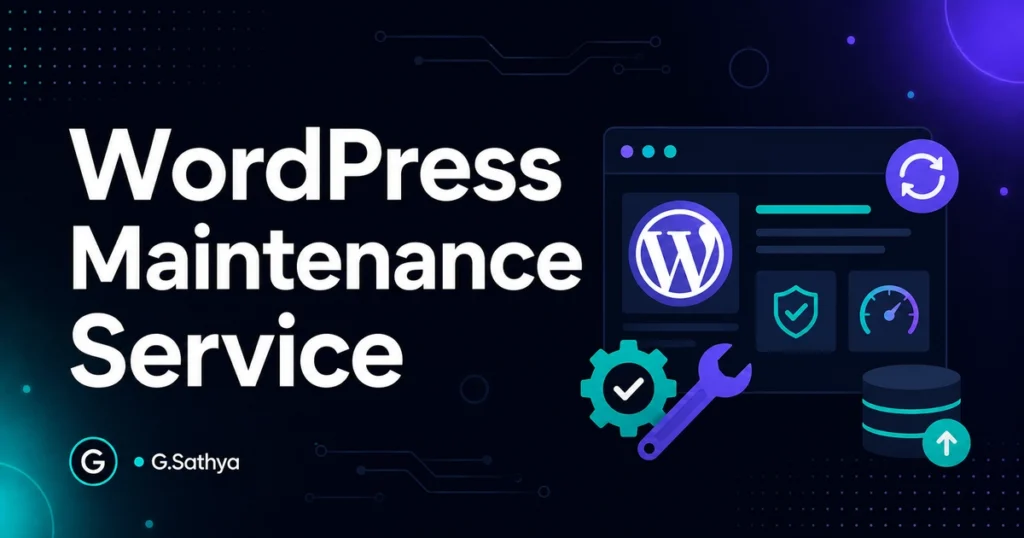
WordPress maintenance is the systematic, proactive engineering routine of testing and deploying core/plugin updates, securing server environments, running off-site backups, optimizing database queries, and auditing performance to keep a website secure, fast, and 99.9% available without breaking revenue-generating workflows.
Over the last decade managing enterprise WordPress infrastructure for ecommerce stores, SaaS companies, and high-traffic publishers across India, the US, UK, and Europe, I have learned that website maintenance is never just about clicking “Update” in the dashboard. Unvetted updates cause white screens of death, broken checkout funnels, and silent database corruption. This comprehensive guide outlines the exact protocols, automation tools, and preventive workflows required to keep WordPress running at peak efficiency.
WordPress Maintenance Strategies Compared: Which Approach Fits Your Business?
Every business approaches website upkeep differently. Here is how common maintenance strategies stack up against real-world security, downtime risk, and total cost of ownership:
| Maintenance Approach | Security Coverage | Uptime Risk | Regression Testing | Ideal Use Case |
|---|---|---|---|---|
| Dedicated Developer Retainer | Proactive 24/7 | Zero (Staging-first deployment) | Full automated & visual regression | Ecommerce, mission-critical business portals, lead-generation sites |
| Automated Auto-Updates | Reactive | High (Plugin conflicts break production) | None (Updates blindly to live site) | Personal hobby blogs, static non-commercial websites |
| In-House Generalist Staff | Moderate | Moderate (Lack deep WP internals knowledge) | Manual, often incomplete testing | Agencies with spare junior developer hours |
| “Break-Fix” (Only When Down) | High Vulnerability | Maximum (Extended emergency outages) | Zero preventive audits | Never recommended. Emergency fixes cost 5x-10x more. |
The 5 Pillars of High-Performance WordPress Maintenance
Professional website upkeep is divided into five disciplined engineering layers:
- Staging-First Update Management: Major WordPress core, theme, and plugin updates must never be tested directly in production. Updates should be deployed to an isolated staging environment and tested against checkout flows and form submissions before promoting to live.
- Immutable Off-Site Backups: Server-level daily and hourly incremental backups stored on Amazon S3, Google Cloud Storage, or Backblaze B2, completely separated from your hosting provider to survive catastrophic server failures.
- Hardened Security & Malware Auditing: Continuous monitoring of WordPress vulnerability databases (WPScan), blocking brute-force attacks, enforcing strong authentication, and scanning file integrity.
- Database Sanitation & Query Tuning: Regularly purging expired transients, orphaned post revisions, spam comments, and overhead from WooCommerce log tables to maintain sub-100ms database response times.
- 24/7 Availability & Core Web Vitals Auditing: Continuous 60-second ping monitoring and automated weekly synthetic performance audits to prevent speed regression from newly uploaded media or scripts.
Technical Implementation 1: Database Hygiene & Maintenance Routine
Over time, active WordPress databases accumulate thousands of expired transients, auto-drafts, and unindexed log rows that slow down wp_posts and wp_options lookups. The following custom maintenance script can be automated via cron to keep your database lean and responsive:
<?php
/**
 * Automated Database Cleanliness & Transients Purge Routine.
 * Schedule via WP-Cron or Server Cron (hourly/daily).
 */
add_action('sathya_scheduled_database_maintenance', 'sathya_run_db_hygiene');

function sathya_run_db_hygiene() {
    global $wpdb;

    // 1. Delete expired transients from wp_options
    $time = time();
    $sql_transients = "
        DELETE a, b FROM {$wpdb->options} a, {$wpdb->options} b
        WHERE a.option_name LIKE %s
        AND a.option_name NOT LIKE %s
        AND b.option_name = CONCAT('_transient_timeout_', SUBSTRING(a.option_name, 12))
        AND CAST(b.option_value AS UNSIGNED) < %d
    ";
    $wpdb->query($wpdb->prepare($sql_transients, '_transient_%', '_transient_timeout_%', $time));

    // 2. Limit post revisions to prevent bloat (keep last 5 per post)
    $wpdb->query("
        DELETE FROM {$wpdb->posts}
        WHERE post_type = 'revision'
        AND ID NOT IN (
            SELECT ID FROM (
                SELECT ID FROM {$wpdb->posts}
                WHERE post_type = 'revision'
                ORDER BY post_date DESC LIMIT 500
            ) as recent_revs
        )
    ");

    // 3. Delete orphaned post meta entries
    $wpdb->query("
        DELETE pm FROM {$wpdb->postmeta} pm
        LEFT JOIN {$wpdb->posts} p ON pm.post_id = p.ID
        WHERE p.ID IS NULL
    ");
}
Technical Implementation 2: Core Security Hardening (Must-Use Plugin)
Preventative maintenance requires locking down attack vectors before automated scanners can probe your installation. Adding this lightweight security module into wp-content/mu-plugins/security-hardening.php protects against the most common automated threats:
<?php
/**
 * Plugin Name: Enterprise Security Hardening (MU)
 * Description: Eliminates common attack vectors and information leakage.
 */

if (!defined('ABSPATH')) {
    exit;
}

// 1. Completely disable XML-RPC to eliminate DDoS and brute force reflection
add_filter('xmlrpc_enabled', '__return_false');
add_filter('wp_headers', function($headers) {
    unset($headers['X-Pingback']);
    return $headers;
});

// 2. Remove WordPress generator version tag from HTML header & RSS feeds
remove_action('wp_head', 'wp_generator');
add_filter('the_generator', '__return_empty_string');

// 3. Block REST API user enumeration scans from unauthenticated users
add_filter('rest_endpoints', function($endpoints) {
    if (isset($endpoints['/wp/v2/users']) && !current_user_can('list_users')) {
        unset($endpoints['/wp/v2/users']);
    }
    if (isset($endpoints['/wp/v2/users/(?P<id>[d]+)']) && !current_user_can('list_users')) {
        unset($endpoints['/wp/v2/users/(?P<id>[d]+)']);
    }
    return $endpoints;
});

// 4. Enforce strict HTTP response headers
add_action('send_headers', function() {
    if (!is_admin()) {
        header('X-Content-Type-Options: nosniff');
        header('X-Frame-Options: SAMEORIGIN');
        header('Referrer-Policy: strict-origin-when-cross-origin');
    }
});
Weekly & Monthly WordPress Maintenance Checklist
Use this comprehensive engineering checklist to verify website health, security, and performance across every maintenance cycle:
- ✓
Verified Off-Site Backup: Complete filesystem and database backup tested and verified on external cloud storage before deploying updates.
- ✓
Staging Regression Pass: All core, plugin, and theme updates tested on staging, verifying critical ecommerce cart flows and contact forms.
- ✓
Vulnerability Patching: Checked active plugins against the WPScan / CVE vulnerability database to apply priority security patches.
- ✓
Database Cleanup & Transients Purge: Removed expired transient caches, unindexed WooCommerce logs, and spam revisions.
- ✓
PHP & Server Compatibility Audit: Verified server runs on supported PHP versions (PHP 8.1+) with active OPcache memory allocation.
- ✓
Core Web Vitals & Broken Links: Checked Google Search Console for crawl errors, 404 broken links, and Largest Contentful Paint (LCP) regressions.
Frequently Asked Questions About WordPress Maintenance
How often should WordPress maintenance be performed?
Security monitoring and automated off-site backups should run daily or in real time. Minor plugin updates and database cleanliness audits should be reviewed weekly. Comprehensive staging regression testing and Core Web Vitals audits should occur monthly.
Can auto-updates replace a human developer?
No. While auto-updates work fine for basic blogs, they frequently break custom layouts, checkout hooks, third-party payment gateways, and API connectors on commercial websites. A skilled developer tests updates on a staging server first, catching regressions before real customers encounter broken pages.
What is the difference between shared hosting backups and off-site backups?
Shared hosting backups reside on the same infrastructure as your website; if your server crashes, gets blacklisted, or suffers hardware corruption, the backup is destroyed along with the live site. Off-site backups are encrypted and shipped to independent cloud providers (such as Amazon S3 or Google Cloud), ensuring you can recover your business even in a total server disaster.
Will updating PHP break my WordPress website?
Updating PHP to modern releases (e.g. PHP 8.2 or 8.3) yields massive speed gains, but legacy or abandoned plugins may throw fatal errors if they use deprecated functions. A proper maintenance process audits your codebase for PHP compatibility on a staging environment prior to switching PHP versions in production.
How does regular maintenance prevent malware and hacking?
Over 80% of hacked WordPress websites are breached due to outdated plugins with publicly disclosed vulnerabilities. Promptly applying security patches, hardening file permissions, disabling XML-RPC, and restricting REST API user enumeration shuts down the vectors exploited by automated botnets.
What happens if an update breaks my website during maintenance?
Because professional maintenance follows a staging-first protocol, bugs are caught and resolved before reaching production. If a rare issue occurs on deployment, having pre-tested database snapshots and version-controlled Git code allows instant rollback within minutes, preventing lost revenue.
Protect Your Business with Professional WordPress Maintenance
Your website is your company’s digital storefront. Leaving updates to chance or letting technical debt accumulate leads to catastrophic downtime, security breaches, and lost sales. With over a decade of hands-on WordPress engineering experience, I provide proactive, white-glove maintenance retainers that give founders and marketing teams total peace of mind.
Explore my dedicated WordPress Maintenance Services or contact me directly for a comprehensive site health and security audit.